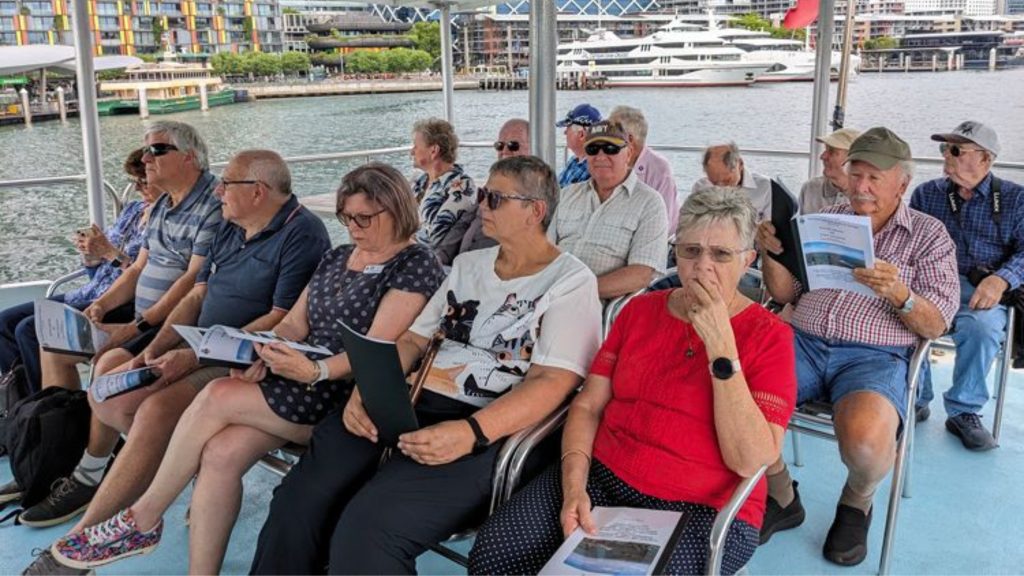
The Glenorie Probus members gathered at King Street Wharf 3 under a bright blue sky streaked with wisps of cloud. For this Naval Historical Cruise, they boarded the MV Bennelong, which was conveniently berthed just across from the Australian Maritime Museum.
Even seasoned locals were surprised by the number and variety of Royal Australian Navy (RAN) sites in Sydney Harbour east of the Harbour Bridge. With commentary covering more than a dozen facilities, there was no time for navel-gazing on this naval adventure.
The MV Bennelong set sail, initially motoring west into White Bay, where the group admired the triangulated support cables of the Anzac Bridge and the large cruise ship Carnival Adventure berthed at the White Bay Passenger Terminal. Turning east toward the Harbour Bridge, a square-rigged tall ship, the Sail Training Ship Young Endeavour, passed silently ahead; sails furled like a ghost ship on the water.
The informative commentary by Noel and Ray then began. Dawes Point was highlighted first, where Lieutenant William Dawes built an observatory, established gun batteries to protect Sydney Cove, and created a government farm. With the help of a young Aboriginal woman, Patyegarang, he compiled the first dictionary of the local Aboriginal language.
Next came Fort Macquarie, a fortification built on Bennelong Point between 1817 and 1821, designed by convict architect Francis Greenway. It was demolished in 1901 for a tram depot, which was removed in 1958 to make way for the Sydney Opera House.
Adjacent to the Opera House are the Man O’War Steps, originally built in 1810 by Governor Macquarie for his private use, later expanded and used by the Navy to water ships anchored nearby.
The finger wharves in Woolloomooloo Bay were originally built for shipping wool, grain, and other freight, but also served departing and returning soldiers in both World Wars. During the latter stages of WWII, they accommodated the British Pacific Fleet.
Garden Island, once a true island, served as a garden for the crew of HMS Sirius under Arthur Philip, growing onions and corn to prevent scurvy. Aboriginal people regularly visited the island, which was joined to the mainland in 1940. The Captain Cook Graving Dock was constructed between 1941 and 1945.
Rushcutters Bay earned its name from convict harvesting rushes for thatching roofs. HMAS Rushcutter, commissioned in 1920, became one of the oldest RAN shore bases, hosting anti-submarine warfare, diving, and radar training.
Clark Island, named Lieutenant Ralph Clark of the First Fleet, hosted convict-tended vegetable gardens, though the produce was often stolen. During WWII, spare barrels for the massive 14-inch guns of the King George V-class battleships were stored there.
HMAS Tingira, a static training ship moored in Rose Bay, trained over 3,000 boys aged 14–16 between 1912 and 1927.
Watsons Bay, named after Robert Watson, the first superintendent of the Macquarie Lighthouse, became the site of gun emplacements, forts, and barracks due to fears of Russian and French attacks. Today, HMAS Watson is a naval training base for officers and sailors.
Georges Head hosted the western end of the WWII anti-submarine boom net and several military fortifications. Chowder Bay, named in the 1830s by whalers making fish chowder, was the site of a Submarine Mining Depot in 1889. Mines were strung across the harbour by 1894 but never fired in combat.
The cruise concluded back at King Street Wharf 3. Volunteers from the Naval Historical Society of Australia delivered a thoroughly enjoyable three-hour experience, offering something of interest for everyone—truly a voyage for those curious about Sydney’s naval history.